
Cabinet Staining vs Painting: Which Finish Lasts Longer in a Minnesota Kitchen?
Your cabinet finish matters more in Minnesota than almost anywhere else. Between the brutal winters, sticky summer humidity, steam from cooking, and the general chaos of daily kitchen life, your cabinets take a beating. And if you pick the wrong finish, you will be dealing with chips, peeling, or warped wood a lot sooner than you would like.
Cabinet staining vs painting is one of the most common decisions homeowners face during a kitchen remodeling project. Both options can look great. Both have real trade-offs. But when you factor in Minnesota's climate specifically, including the freeze-thaw cycles, the moisture swings, and the dry indoor heat all winter, the choice gets more interesting.
This guide breaks down cabinet staining vs painting durability, maintenance, appearance, cost, and long-term value so you can make the right call for your kitchen.
Quick Answer: Cabinet Staining vs Painting
Stained cabinets generally last longer than painted cabinets in Minnesota kitchens.
Stain handles humidity and seasonal wood movement better, reducing the risk of cracking or peeling.
Painted cabinets offer unlimited color options and suit modern kitchen designs.
Stained cabinets hide scratches, dents, and daily wear more effectively.
Painted cabinets require more frequent touch-ups, especially in high-use areas.
Solid hardwood cabinets (maple cabinets, oak, walnut, cherry, hickory) perform best with stain.
For most Minnesota homeowners comparing cabinet staining vs painting, stain provides the best combination of durability, low maintenance, and long-term value
What Is Cabinet Staining and How Does It Work?
Cabinet staining is a wood finishing process where a pigmented or dye-based stain is applied directly to bare wood. Unlike paint, stain soaks into the wood fibers rather than sitting on top of them. The result is that the natural grain and texture of the wood stays visible, and honestly, it looks really good on the right species.
After the stain is applied and dried, a protective topcoat, usually polyurethane, lacquer, or conversion varnish, goes on top. That topcoat is what actually protects the wood from moisture, scratches, and daily wear. The stain just sets the color and enhances the grain.
What Are the Benefits of Stained Cabinets?
In cabinet staining vs painting, stained cabinets are the right choice when durability and a natural look are the priority. Here is why homeowners, especially in climate-stressed regions like the Twin Cities, keep choosing them.
Better at hiding wear. Small scratches, dents, and everyday scuffs blend into the wood grain. On painted cabinets, the same damage is obvious.
Handles wood movement well. Minnesota's seasonal humidity swings cause wood to expand and contract. Because stain is absorbed into the wood rather than sitting on top, it's less likely to crack or peel when wood moves.
Low-maintenance over time. Once properly sealed, stained cabinets need very little upkeep beyond regular cleaning.
Timeless aesthetic. Wood grain never really goes out of style. A warm, honey oak or rich walnut stain will look as good in 15 years as it does today.
Easier spot repairs. Scratches can often be touched up with a matching stain pen or light sanding and recoating without redoing the whole cabinet.
Breathes naturally. Stain allows the wood to respond to humidity more naturally, which reduces stress on the finish itself.
Long lifespan. A well-applied stain with a quality polyurethane topcoat can last 10-15 years or more before needing a full refinish.
Adds warmth to kitchen spaces. Especially in Minnesota homes where natural light is limited in winter, warm wood tones create a more inviting atmosphere in kitchens.
Need help deciding whether stain or paint is right for your kitchen? Visit Barnett Cabinet Painting and Refacing to explore professional cabinet refinishing solutions built for Minnesota homes.
Challenges of Stained Cabinets
Stained cabinets are durable and low-maintenance, but they're not perfect for every kitchen. The biggest limitations come down to color flexibility, material compatibility, and how much effort a future update would take.
Limited color options. You are mostly working within the natural tones of wood, including brown, amber, walnut, and grey wash. If you want white, cream, or navy cabinets, paint is the only real option.
Wood species matters a lot. If your cabinets are made from MDF (Medium-Density Fiberboard), particleboard, or low-quality wood, staining will not work well, or at all.
Harder to update the look. Switching from stain to paint requires significant prep work, including sanding and priming. It's doable, but it's a bigger project.
Shows grease more visibly in some finishes, particularly satin or matte topcoats near cooking areas.
What Is Cabinet Painting and How Does It Work?
Cabinet painting involves applying a primer coat followed by one or more coats of paint directly to the cabinet surface. Unlike stain, paint sits on top of the wood. It completely covers the grain and creates a smooth, uniform surface. That is the main visual difference.
The best results come from proper prep: sanding, deglossing, and priming. Skip those steps and you will see peeling within a year. Done right, though, painted cabinets look clean and polished.
Modern cabinet painting typically uses alkyd, water-based acrylic, or two-component finishes. Sherwin-Williams Emerald Urethane and similar cabinet-specific paints have made a big difference in durability over the last several years.
Recommended Read: Cabinet Painting Process Guide
What Are the Benefits of Painted Cabinets?
Painted cabinets are the go-to for homeowners who want design flexibility and a crisp, modern kitchen look. The benefits are real:
Unlimited color choices. Any color you can imagine, including white, sage, navy, black, and pastels. Paint gives you total creative control.
Covers imperfections. Got a cabinet with minor surface damage or an uneven grain? Paint hides it completely.
Works on more materials. Paint adheres well to MDF, particleboard, and other engineered wood products that don't stain well.
Bright and airy feel. Light-colored painted cabinets open up a kitchen visually, which is great for smaller spaces.
Easy to refresh. Want a new look in 5 years? Repainting is faster and cheaper than replacing cabinets.
Clean, modern aesthetic. Painted surfaces read as contemporary and intentional, which works well in renovated Twin Cities homes.
Consistent finish across mixed materials. If your kitchen has a mix of wood species or cabinet types, paint unifies the look.
Strong demand at resale. White or neutral painted cabinets still test very well with home buyers.
Challenges of Painted Cabinets
Painted cabinets look great when they are fresh, but they do demand more ongoing attention than stained ones, especially in a high-use Minnesota kitchen where humidity and temperature swings are part of life.
Shows chips and wear visibly. Especially along edges and corners. Once paint chips, it looks bad fast.
More sensitive to humidity and moisture. Paint film can bubble, peel, or crack when wood expands and contracts.
Touch-up matching is hard. Paint colors shift slightly as they age, so spot-touching a chipped area can result in visible color mismatches.
Not ideal for heavy-grain wood. On oak, the grain texture shows through paint ("grain telegraphing"), which some homeowners dislike.
Can feel cold or clinical in some finishes if the color or sheen isn't chosen carefully.
Recommended Read: Cabinet Painting Mistakes (And How to Avoid)
Cabinet Staining vs Painting Durability: Which is Better For Minnesota Kitchen?
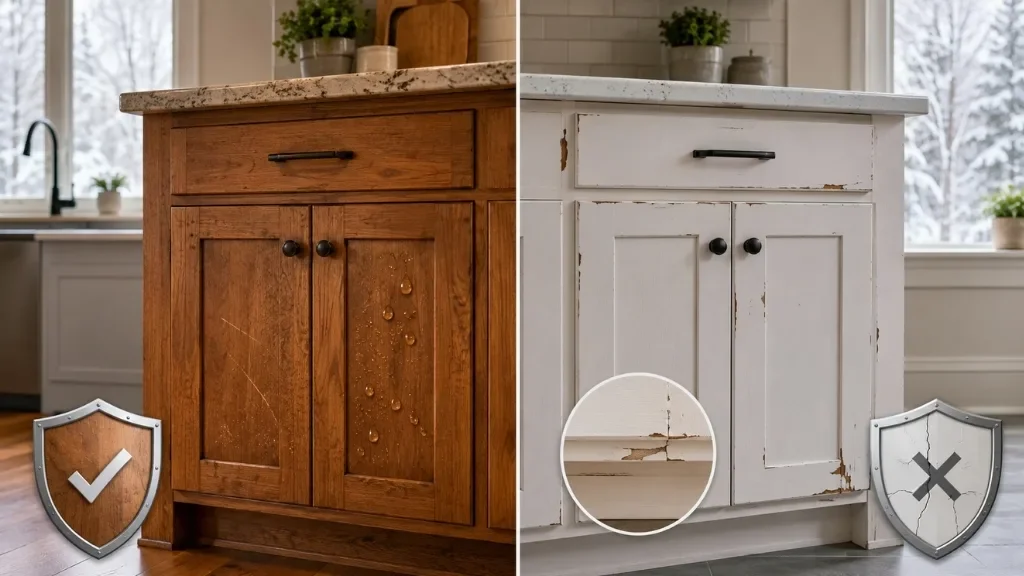
When evaluating cabinet staining vs painting durability, stained cabinets generally last longer than painted ones, especially in high-use kitchens and climates with seasonal humidity swings like Minnesota. That said, the right topcoat and application quality matter just as much as the finish type itself.
Durability & Wear Resistance
When it comes to raw durability, stained cabinets with a quality polyurethane topcoat have an edge, especially in working kitchens. Scratches and small dings blend into wood grain naturally. On painted cabinets, the same damage creates a visible chip that draws the eye immediately.
That said, modern cabinet paints have improved dramatically. Two-component urethane finishes are genuinely hard and hold up well. So the gap has narrowed. But stain still wins on forgiving everyday wear.
Style & Aesthetic Differences
Paint gives you a clean, smooth surface with unlimited color options. Stain gives you warmth, texture, and a natural character that paint simply can't replicate.
In the debate of painted cabinets vs stained cabinets, neither is objectively better. It is about what fits your kitchen's design direction. When comparing painted vs stained kitchen cabinets, painted cabinets lean modern and minimal, while stained cabinets lean traditional, rustic, or transitional.
Cost Comparison
Costs vary by contractor and project scope, but here's a general picture of cabinet staining vs painting:
Cabinet staining typically runs slightly less per linear foot than painting when done professionally, though it depends heavily on wood species and current finish condition
In terms of cabinet painting vs staining, cabinet painting can cost slightly more due to additional prep steps (priming, multiple coats) and labor time.
Refinishing existing cabinets (either stain or paint) is significantly cheaper than cabinet refacing or replacement
Premium wood species like cherry or walnut increase staining costs; premium paints or two-tone designs increase painting costs
Recommended Read: Cost to Paint Kitchen Cabinets (2026 Guide for Minnesota Homeowners)
Maintenance Over Time
In terms of cabinet maintenance, stained cabinets require less maintenance than painted cabinets. They need less frequent maintenance, including regular wiping with a mild cleaner, occasional wood conditioning, and a full re-stain every 8 to 15 years. Scratches can often be touched up without professional help.
Painted cabinets need more attention. Touch-ups happen more often, especially in busy kitchens. And because paint color shifts slightly over time, those touch-ups are not always invisible.
Better Long-Term Value?
For long-term investment, stained cabinets generally hold up better in Minnesota homes. They handle the climate stress better, need fewer repairs, and age more gracefully. Painted cabinets offer great value too, especially for homeowners planning to sell within a few years, since neutral painted cabinets tend to appeal broadly to buyers.
Which Cabinet Finish Is More Popular in 2026?
Painted cabinets are still the dominant choice nationally in modern kitchens. White and neutral tones have led kitchen design trends for the better part of a decade. But stained wood is making a real comeback.
The shift toward warm, natural interiors, including biophilic design, natural textures, and earthy palettes, has brought stained wood back into modern kitchen spaces in a big way. In the Minneapolis and Saint Paul market specifically, mid-tone oak stains and walnut finishes are showing up in high-end renovations far more than they were five years ago. So, both finishes are strong in 2026. It is less about trends and more about what fits your specific kitchen.
| Feature | Painted Cabinets | Stained Cabinets |
|---|---|---|
| Style | Smooth, modern, versatile | Warm, natural, textured |
| Cost | Slightly higher finishing cost | Varies by wood species |
| Maintenance | May need touch-ups | Low-maintenance |
| Durability | Shows chips more easily | Hides wear effectively |
| Trendiness 2026 | Still dominant | Surging in demand |
How Minnesota's Climate Affects Cabinet Finishes?
Minnesota kitchens face conditions that most cabinet finish comparisons simply do not account for. This is not Phoenix. It is freeze-thaw country with real humidity swings and months of forced-air heat that dries everything out indoors.
1. Humidity and Moisture Resistance
Summer humidity in the Twin Cities regularly pushes past 70 to 80 percent relative humidity, and wood absorbs that moisture and swells. When the finish is not flexible enough to move with the wood, you get bubbling, cracking, or peeling. That is before you factor in the daily steam from cooking and water splashes near the sink and dishwasher. In those high-exposure zones, finish quality matters enormously.
Stain absorbed into the wood fiber moves with it naturally. It does not fight the expansion. Paint, sitting on top as a film, is more likely to crack or peel when wood swells significantly. A high-quality topcoat on either finish helps, but stain has an inherent structural advantage in humid conditions.
2. Seasonal Expansion and Contraction of Wood
This is probably the biggest climate-specific factor for Minnesota homeowners. Wood expands in the humid summer months and contracts in the dry, heated indoor air of winter, and that cycle repeats every single year. Paint film, especially older or lower-quality formulations, cracks along joints and edges as wood moves. Over several years those cracks allow moisture intrusion, which accelerates deterioration from the inside out.
Stain wins here because it is part of the wood rather than a coating on top of it. It flexes with seasonal movement far more naturally. If your home has significant humidity swings, especially without a whole-home humidifier in winter, stained cabinets will generally perform better over a 10+ year horizon. Painted cabinets can absolutely work, but they need a quality primer and paint system specifically designed for wood movement.
Which Is the Best Cabinet Finish for Kitchens in Minnesota Homes?
For most Minnesota homeowners, stained cabinets perform better long-term. While both stained and painted cabinets can enhance your kitchen's appearance, the best choice depends on your home's style, maintenance preferences, budget, and durability expectations. Minnesota's cold winters, humid summers, and daily kitchen activity all play a role in how each finish ages over time.
When Stained Cabinets Are the Best Choice for Minnesota Homes
Staining is the stronger option when durability and low maintenance are the priority. If your cabinets are solid hardwood and your home experiences real seasonal climate swings, stain will almost always outlast paint with less upkeep.
Your cabinets are solid hardwood, especially oak, hickory, cherry, or walnut.
You want a warm, natural aesthetic that works across multiple design styles.
You are staying in the home long-term and want a finish that ages gracefully.
You live in an older home with significant seasonal humidity and temperature swings.
You want fewer maintenance headaches and less frequent touch-up work over time.
Your kitchen sees heavy daily use with kids, pets, or frequent cooking.
You want a timeless look that will not feel dated in 10 years.
You are prioritizing long-term durability over short-term design trends.
When Painted Cabinets Are the Best Choice for Minnesota Homes
Paint is the best choice when design flexibility and modern aesthetics are most important. It's also the better option when the cabinet material itself isn't ideal for staining.
You want a specific color that does not exist in natural wood tones, such as white, sage, or navy.
Your cabinets are MDF, particleboard, or a lower-grade wood that does not stain well.
You are planning to sell the home within a few years and want broad buyer appeal.
You are going for a bright, modern, or minimalist kitchen design.
The kitchen has limited natural light, and lighter cabinet colors would help open the space.
You want a two-tone kitchen look with painted lowers and stained uppers or open shelving.
Your budget is tighter and you want the option to repaint affordably in the future.
You prefer a clean, seamless surface without visible wood grain.
Our Recommendation for Most Minnesota Homeowners
For homeowners focused on durability, longevity, and easier maintenance, stained cabinets are often the better investment, particularly if your cabinets are solid hardwood and your home experiences significant seasonal climate swings.
For those seeking a bright, modern, and highly customizable kitchen design, painted cabinets remain an excellent choice, especially with today's higher-quality cabinet paint formulations.
In Minnesota's climate, stained finishes generally handle seasonal wood movement and everyday wear more effectively. But the best option ultimately depends on your cabinet material, household lifestyle, maintenance expectations, and remodeling goals. There is no universally wrong answer, just the right answer for your specific situation.
Final Thought: Cabinet Staining vs Painting
At the end of the day, both finishes can perform well in a Minnesota kitchen. The difference comes down to how they are applied and what you are working with. The wood species, the quality of the topcoat, and how well the cabinets were prepped all matter more than most people realize.
Stain tends to age better in homes where wood movement is a factor. Paint tends to hold its value better at resale and gives you more design flexibility. Neither choice is set in stone. Both can be refinished down the road if your needs change.
The real long-term investment is not just the finish. It is the quality of the underlying cabinet construction. A great finish on a poorly built cabinet will not save you much. But a well-applied stain or paint job on solid hardwood? That is a kitchen that holds up.
Ready to update your kitchen cabinets? Get Your Estimate today and discover the best refinishing option for your style, budget, and goals.
FAQs
-
Yes, stained cabinets are more durable than painted ones because stain soaks into the wood and moves with it through humidity changes, while paint sits on top and is more likely to chip or crack over time, especially in a climate like Minnesota's.
-
Painted cabinets still lead in modern kitchens, but stained wood is catching up fast. Warm oak and walnut tones are showing up a lot in contemporary and transitional kitchen designs right now.
-
Yes, and it looks great when done right. Painted lowers with stained uppers, or a painted island against stained perimeter cabinets, are both popular two-tone combinations in 2026.
-
Cabinet painting tends to be slightly higher in cost because of the extra prep, including priming, multiple coats, and more labor time. Staining costs vary depending on wood species and the condition of the existing finish.
-
In a busy kitchen, plan on minor touch-ups every 2 to 4 years, mostly around door edges, hinges, and handles where daily contact wears the paint down first.
-
Yes, stained cabinets do increase home value, particularly on solid hardwood. Buyers who care about quality materials tend to respond well to natural wood finishes, as it signals that the cabinets are built to last.
-
For long-term performance, stained cabinets with a durable topcoat hold up better against Minnesota's humidity swings and seasonal wood movement. Painted cabinets are the better pick if modern aesthetics or broad resale appeal matters more.
-
No. Stained cabinets typically last longer because the stain penetrates the wood rather than sitting on top of it. Paint is a surface film. It chips, peels, and cracks over time, especially in kitchens with heavy use or humidity swings.